


THE MASTER
**1/2
DIRECTED BY Paul Thomas Anderson
STARS Joaquin Phoenix, Philip Seymour Hoffman
There’s a great scene in Milos Forman’s 1984 Oscar winner Amadeus when Mozart (Tom Hulce) tries to convince Emperor Joseph II (Jeffrey Jones) to allow him to stage a particular opera. Replies the Emperor, “You are passionate … but you do not persuade.”
That snatch of dialogue might as well be a mini-review for Paul Thomas Anderson’s The Master, the latest from the writer-director of There Will Be Blood and the instant masterpiece Boogie Nights. The Master features passionate performances from its stars, Joaquin Phoenix and Philip Seymour Hoffman. It’s obviously a work of passion for its creator, who stages it with his typical flair and inventiveness. And yet it never quite persuades us to believe in its convictions, its viewpoints, even its sense of purpose.
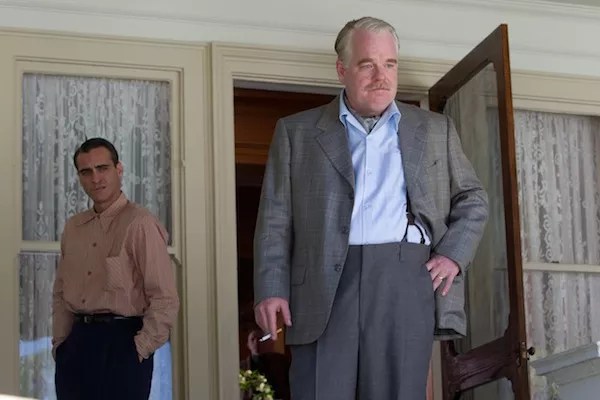
Phoenix essays the role of Freddie Quell, a World War II vet who returns to the world in a shell-shocked condition. An often temperamental man, he soon becomes a disciple of sorts to Lancaster Dodd (Hoffman), the founder of a religion known as The Cause. No one, not even Dodd’s wife Peggy (Amy Adams), can understand why such a cultured gentleman like Lancaster would hang around an uncouth thug like Freddie. But it’s a relationship that works in spurts — and that pretty much describes the film itself.
Although Lancaster Dodd and The Cause are clearly based on L. Ron Hubbard and Scientology, the movie approaches the religion from such a safe, soft distance that it’s hard to get a proper slant on either its inner workings or outer appeal. This problem would perhaps have been alleviated by making Lancaster Dodd, the picture’s most interesting character, the protagonist, but this is clearly Freddie’s story, thereby keeping audiences at an unfortunate distance.
The Master contains some genuinely powerful scenes and probably warrants a second viewing, but for the most part, even true believers of Paul Thomas Anderson might lose some of their faith after kneeling before this heavily hyped, but curiously airless, endeavor.
Related Stories

Her: Computer blue

Inherent Vice provides a contact high
This article appears in Sep 19-25, 2012.


At least one professional critic is willing to admit The Master is a long, slow mess where motivation & plot disappear into Anderson’s lovingly crafted shots and Greenwood’s There Will Be Blood reductive score. While that film had power, money & ambition to anchor its ethereal movement, The Master has nothing in the way of explanation for the relationship between its characters. Is it a scam? Is Freddie a convert, believer & protector? Why does The Master care for him? By the time an entirely pointless motorcycle ride in the desert comes you realize its a metaphor for this film and you just want to go watch The Avengers again. I loved Magnolia, which was a hot mess, but a captivating, enjoyable hot mess, whereas The Master suffers from an inability to tell a story let alone be willing to edit its run time to a bearable pace. At least the other auteur mishit of the summer, Moonrise Kingdom, realized it wasn’t quite working and cut out a romantic triagle subplot to make it a manageable 90 minutes. On the other hand, the cast, especially Amy Adams and Phoenix, deserve recognition for strong performances in an otherwise incoherent emotional narrative.
THANK YOU!
I’m confused. Do we have to have films with clear cut villans and heros like in Amadeus, to have “good films?” With cookie cutter characters and predictable plots? “You are passionate…but you do not persuade?” Duh, this is the mystery of human nature. What persuades or seduces one person does not persuade/seduce another. There are sharks swimming among minnows.
Nothing in the way of explanation or relationship? Why does Freddie care for the Master or viceversa? Perhaps Freddie longs for a father, or a family like more and more Americans of the post WWII generation do. Cults, and organizations like cults provide purpose and comfort our society has lost, or disregarded. Are they a scam is almost beyond the point.
One piece of advice – the nature of The Cause is irrelevant. It is not a film about that and it never was. It’s not an expose on religion or Scientology. Rewatch the film ignoring that and you will see it differently.
What is Freddie Quell? What are his motivations? What does he represent? The incredibly disciplined screenplay and performance asks these questions without answering them.
That is the genius of the film. For once you are not being told how to feel about the subject – it is what it is. Quintessentially post-modern, I found it to be mesmerizing.