


SHUTTER ISLAND
***
DIRECTED BY Martin Scorsese
STARS Leonardo DiCaprio, Mark Ruffalo
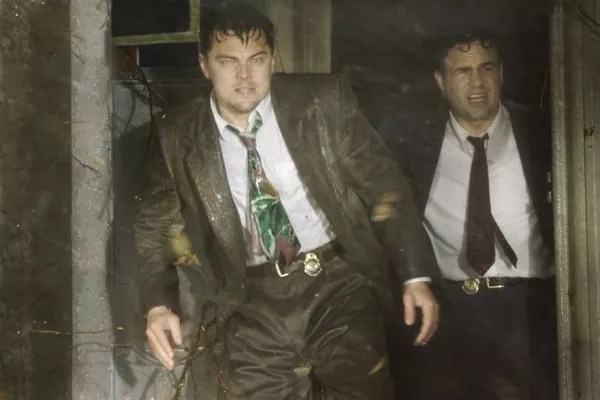
Just how obvious is the big “twist” that concludes Shutter Island, Martin Scorsese’s adaptation of Dennis Lehane’s novel? So obvious that some folks who haven’t read the book are figuring it out simply by watching the trailer. But just how accomplished is the picture anyway? Enough that viewers will happily be led down the rabbit hole by a director with the ability to distract them with every technique at his disposal.
Delivering yet another topnotch performance that might help him win some sort of lifetime achievement award before he even hits 40, Leonardo DiCaprio stars as Teddy Daniels, a U.S. federal marshal who, with his new partner Chuck Aule (Mark Ruffalo), travels to a mental asylum located on a remote island off the Massachusetts coastline. The year is 1954, and the lawmen are there to investigate the disappearance of one of the inmates. But although the head of the facility (Ben Kingsley) assures them that they’ll have the full cooperation of the entire staff, it soon becomes apparent that everyone has something to hide, and Teddy must suss out the truth even while plagued by debilitating headaches, gruesome flashbacks to his World War II years, and disturbing hallucinations involving his deceased wife (Michelle Williams).
Scorsese’s in pulp fiction mode here (see also Cape Fear and The Departed), which essentially means that this is one of those pleasing instances when “B”-movie material is given the “A”-list treatment. The screenplay by Laeta Kalogridis is packed with so much intriguing incident that it’s easy to not even notice the plotholes until post-movie reflection, and all the craftspeople who won Oscars for Scorsese’s The Aviator are back on board, resulting in an immaculate presentation that fully engages the senses. And while the major plot pirouette will disappoint discerning viewers, it’s followed by a deliciously ambiguous coda that insures all moviegoers will exit the Island with at least something to ponder.
Related Stories

The Wolf of Wall Street indulges in overkill

The Drop gets a rise
This article appears in Feb 16-22, 2010.


I have generally always agreed with movie reviews in Creative Loafing. However, I would have to disagree with this review seeing as how I fell asleep for a few minutes during it and also seriously considered walking out after almost an hour and forty-five minutes of watching it. (I figured it was almost over, it wasn’t). Yes, the scenes are shot well and there is brilliant imagery that only Scorsese could provide. But that’s about it for this sleepfest. Save your money and wait for it to come out on HBO.
You know what I had the same reaction as you until I realised I had it ALL wrong. The twist wasn’t that he was the inpatient (seriously I think everyone saw that coming from a mile away!) the twist was the intervention actually worked. He was cured, he deliberately made it look like he relapsed because he did not want to live with the memory of what happened to his family. He blamed himself for ignoring that his wife was clearly unstable. The line “would you rather die as a good man or live as a monster” Depicted he wanted to die as a good man (lobotomized) then live with the memory of what happened. Also the symbolism of fire and water tells you when he is hallucinating (fire) and when he is lucid (water trickling through.) The delusion he concocts to save himself from accepting the truth is that his wife died in a fire. All the people he talks to surrounded by fire is a hallucination – the woman in the cave, the patient in the cell, the scarred faced man who he thinks killed his wife, the car blowing up – all a delusion. The water symbolizes reality trying to break through. He is afraid of water – (his kids were drowned they all died in front of the lake.) Also at the start he says he gets ‘sea sick’ – he is mortally afraid of water. He has to swim to get to the lighthouse.
The movie is full of symbolism. I think what throws people off kilter a bit is the dream like sequences that they think is there to just enhance the show. It confuses people into thinking is that a dream? a hallucination or is that a flashback? This is definitely a movie that you have to see more then once to pick up the real affect – which really is brilliant. I have only seen it once myself. I really do have to see it again.
If you already knew this and still didn’t like it then please ignore this comment 🙂
Tania I think you may be right, that cleared up a lot for me. At first I thought he really was Teddy Daniels, and in the end he realized that there was no way he could escape shutter island, knowing that they could turn everything against him and claim it as part of his insanity. In the end he just accepted that and decided to “die a good man” rather than go along with their ploy and live as the monster they told him he was. I still think the car exploded though, just because the doctor at the top of the light house claimed that it did and that it was his favorite car. I also thought George, the prisoner in the cell, was real, and this justified why the lighthouse was empty when he got to it, because as the doctor stated he knew Ted talked to George and what they talked about, which would have given him the oppurtunity to clear the house and would also explain why he was at the top of it. I’m not so sure about that ending now, because I completely forgot that he was seasick in the beginning, and it makes perfect sense when this is translated to his drowning children, which would imply that he really is Andrew. Haha so now I’m even more confused, I really will have to see it again
I also agree with Tania, but believe there could be even more too it. By the end of the film he could either be Teddy or Andrew. There are clues leading to both, the major one that points to him being Teddy is when Ben Kingsly’s charter says he “never had a partner” that kind of manipulation seems unnecessary too the healing process or to the “game.”
The main clue to him being Andrew, besides the fact that it makes the most sense, is how Ben Kingsly knew in depth his dreams and hallucinations, as though he was told before.
There are lots more to both, I just dont have the time, my point being though, the meaning of the last line. If he is Teddy, hes telling Chuck(or his doctor) he rather get lobotomized then live with these lies. If he is Andrew, though, hes telling Chuck he rather get lobotomized now, than face the reality of what he did to his wife.
I didn’t piece this all together immediately after watching so I hated it, but on my drive home I started thinking about it, and thats when I realized the worth of the film. Not as fun as other Scorsese films, but absolutely worth it.
though if he were Teddy, there would be no way he would so eagerly give up his case and knowingly submit himself to a lobotomy. i think youre right and it’s clear that the treatment was successful and brought him to back to reality. though he, as andrew, chose to be lobotomized to escape his againfound torment. those thoughts on the fire are interesting, they just spun me out i didnt know what to think. definitely deserves a rewatch or 5.
When he mentioned that after Delores attempted suicide the first time she told him she had an insect inside her brain, I was convinced he was Andrew. I don’t remember that detail ever coming up earlier in the movie, and why would he invent that detail?