


BLACKKKLANSMAN
***1/2 (out of four)
DIRECTED BY Spike Lee
STARS John David Washington, Adam Driver
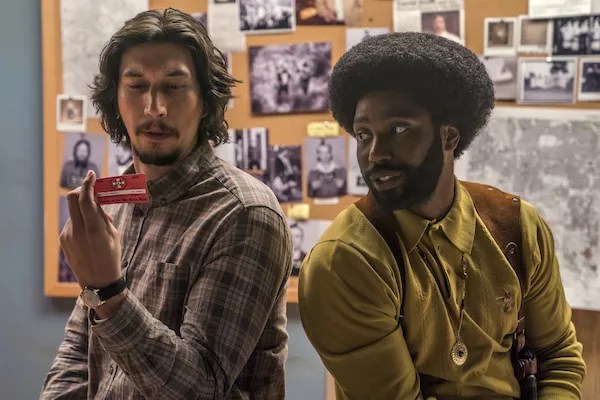
When was the last time that Spike Lee directed a movie that mattered? And by “mattered,” I mean when was the last time he helmed a film that was seen by audiences, championed by critics, and discussed by the establishment? For my money, the rhyme-and-reason endeavor Chi-raq (reviewed here) should have been that film – it made my own 10 Best list for 2015, but it earned less than $3 million at the box office and hit Blu-ray a mere seven weeks after debuting theatrically. No, one would have to go all the way back to 2006’s Inside Man to find a Spike Lee Joint that was viewed by more than just a handful of his strictest devotees.
With that in mind, here’s hoping that BlacKkKlansman receives the following it deserves. Loosely based on a true story, it centers on Ron Stallworth (John David Washington, Denzel’s son), who during the 1970s was a rookie — and the first African-American officer — with the police department in Colorado Springs. Desperately wanting to become an undercover officer, he gets his wish when he’s assigned to attend a speech by Stokely Carmichael and ascertain whether the former Black Panther’s call for a revolution should raise any concerns. Ron reports back that Carmichael’s fiery rhetoric was merely grandstanding, an opinion backed by two white colleagues also involved with the assignment, Flip Zimmerman (Adam Driver) and Jimmy Creek (Michael Joseph Buscemi, Steve’s lookalike brother).
Ron’s next task is one he roots out himself, and one he feels might lead to something more dangerous than mere rhetoric. Answering a newspaper ad placed by the local Ku Klux Klan chapter, Ron begins a dialogue by passing himself off as a white man who hates blacks, Jews and everyone else destroying white America. Ron’s duplicity is successful enough that he lands a meeting with the local Klan yahoos, but since he’s the wrong skin color, he sends Flip to serve as his visual counterpart for in-person meetings while he continues to handle phone duties. His infiltration is so successful that he ends up engaging in a series of telephone chats with no less than David Duke (cue the unexpected though effective casting of Topher Grace), the KKK head who in recent times is better known as Trump’s greatest cheerleader and kindred spirit.
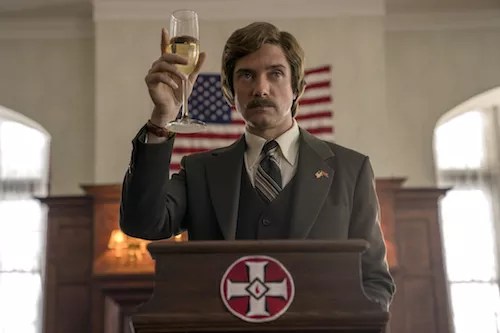
The humor in BlacKkKlansman is occasionally overdone, and yet it never dilutes the suspense generated by the overarching fear that the lives of Ron and Flip are in peril every moment of every day. Some will complain that the Klan members and their enablers are painted in strokes that are far too broad, but I say nonsense. The dialogue spoken by the racist characters is often atrocious and painful to the ears, but that’s to be expected when dealing with Americans as illiterate, insidious and evil as the ones on parade throughout this picture. Only Trump supporters will object to what they will see as caricatures but everyone else will see as stone-cold reality. Of course, it’s not as if right-wing reactionaries will be found anywhere near this film – like most important movies of recent vintage (such as last year’s The Post), it’s strictly a speaking-to-the-choir effort, unlikely to change the dim minds of those who see “fake news” conspiracies everywhere.
Speaking of Trump, his dark soul clogs every pore of this powerful picture. This is especially true in the moments when Lee draws upon actual footage from the Charlottesville rally in which Trump’s neo-Nazi groupies were directly responsible for the death of a young woman. (It’s no coincidence that the movie is being released on the one-year anniversary of that grotesque march.) Admittedly, Lee’s rush to tie the past to the present leaves the film with too many loose threads dangling at the end. On the other hand, when the present is so putrid and precarious that hope and change need to take effect ASAP, who can blame the maverick filmmaker for his empathy and outrage?
Related Stories

Chi-raq: Rhyme and reason

Film 2015: The Best & Worst
This article appears in Aug 8-14, 2018.


