


Lake Norman, Mountain Island Lake, Lake Wylie (a.k.a. the Catawba River) — all of that water belongs to you. And by “you,” I mean “We The People.”
That water is the same water flowing through pipes into your homes and businesses and into your bodies. Your government is supposed to be protecting it. So, why is Duke Energy allowed to drain arsenic into it? Because coal ash, that’s why.
When the company exceeded the U.S. Environmental Protection Act’s arsenic standard in 2004, 2010, 2012 or earlier this year it was totally legal. And Duke didn’t break the law on June 20, 2016, either, when the arsenic levels draining out of its waste into your drinking water reservoir — Mountain Island Lake — was recorded at more than nine times the federal safety standard. Why? Because it has a permit.
Arsenic is poisonous, but there’s no limit placed on how much of it Duke is allowed to drain into your drinking water reservoir. And yet the company has to drain its coal ash dumps at its Riverbend coal plant into Mountain Island Lake; it’s part of the cleanup process, a necessary evil. Besides, there’s a deadline to keep.
Remember the 2014 Dan River spill and the federal investigation that followed? Remember when Duke pleaded guilty to nine criminal violations of the Clean Water Act last year? The cleanup is part of that ongoing aftermath.
Following the spill, the General Assembly passed the Coal Ash Management Act, (CAMA) which Gov. Pat McCrory, a former employee of Duke Energy for 29 years, allowed to become law sans his signature. The act created a classification system that established cleanup deadlines. For the Riverbend plant, that deadline was December 2019. Since there’s roughly 3.6 million tons of coal ash there, it’s going to take a minute to haul it away. But before that can happen, the company must drain the water from it, even though that means discharging arsenic into your water.
On July 15, McCrory signed House Bill 630 into law. The new law eviscerates CAMA and will allow Duke Energy to cap some existing coal ash ponds in North Carolina once deemed intermediate-risk, rather than excavate them. Regardless, due to other factors that include lawsuit settlements among other things, the clean-up at the Riverbend site will continue.
Before your water is sucked out of the lake, it’s tested many times, then tested many times more at the treatment plant. Mecklenburg County and Charlotte Water are paying close attention, but they’re powerless. There are currently no local ordinances limiting arsenic levels and HB 630 bans local governments from passing any.
Still, Mecklenburg County intensified its monitoring of the lake’s surface water near the Riverbend coal ash dumps way back in 2004, years before any of us had ever heard of the stuff. Since then, Rusty Rozzelle, a program manager for Mecklenburg Water Quality, says, “We’ve had six exceedances of the surface water quality standard for arsenic, which is 10 parts per billion.” Those exceedances ranged from 16 ppb to 92 ppb, which is what his team recorded on June 20.
Rozzelle shares the county’s monthly monitoring data with Charlotte Water. Collectively, they determine if the water is fine or not. And it is. The N.C. Department of Environmental Quality (DEQ) agrees with them, as does Duke Energy and EPA, according to its drinking water standards and its 2011 National Pollutant Discharge Elimination System (NPDES) permit that doesn’t limit the amount of arsenic Duke can discharge.
Arsenic is heavy; it sinks. So, it’s no surprise that when DEQ “investigated” on July 7, weeks after Duke Energy stopped discharging its wastewater due to the spike, no arsenic was found in the surface water. But arsenic doesn’t magically disappear once it’s released into the water. It can dilute and drift off, it can hook up with a bit of sediment and sink or settle on a bank. But it doesn’t vanish.
In the summer, the oxygen beneath the water’s surface is depleted and the arsenic there morphs into arsenic trioxide. According to the Agency for Toxic Substances and Disease Registry (ATSDR), “Small amounts of arsenic trioxide can lead to multiple organ damage and death.”
Dr. Avner Vengosh, of Duke University’s Nicholas School of the Environment, has been researching coal ash and publishing peer-reviewed studies on his findings in academic journals at the rate of about one per year since finding that the coal ash from the disaster in Tennessee could harm the environment seven years ago.
In 2012, one of Vengosh’s reports stated, “In Mountain Island Lake, a primary source of drinking water for Charlotte, pore water samples collected from lake sediment during the summers of 2010 and 2011 contained up to 250 parts per billion of arsenic – roughly 25 times higher than current EPA standards for drinking water, and nearly twice the EPA standard for aquatic life.”
I keep asking DEQ if they’re paying attention to Vengosh’s coal-ash research, but they don’t bother to answer when asked if they’re aware of his latest study. He says they haven’t called. (Vengosh has also reported on the waste’s radioactivity, found ways to trace contamination back to individual coal ash dumps and discovered new ways to monitor the waste.)
The reports on arsenic — from Duke University and Mecklenburg County — are no surprise to Duke Energy. The company monitors its wastewater, too, and was already aware of the spikes. They had noticed an “upward trend” in arsenic levels, according to spokesperson Zenica Chatman. She also said when the county confirmed the latest, largest arsenic spike, the company stopped discharging wastewater from the coal ash basins. They’ll resume in September, but this time with a filtration system, she said.
I asked why the company didn’t stop discharging the wastewater when it noticed the upward trend, especially in the summer when there is less oxygen in the lake.
Chatman replied, in part: “The sample point where the elevated levels occurred was very close to the plant in the cove, which is our ‘mixing zone’ — an area that the state allows a permitted industry to return wastewater. Levels need to meet the state surface water standard (10 ppb) outside that area in the main channel of the lake, which had never been affected. If we had started to observe increasing levels in the main channel of the lake, that would have been our signal to suspend the process sooner.”
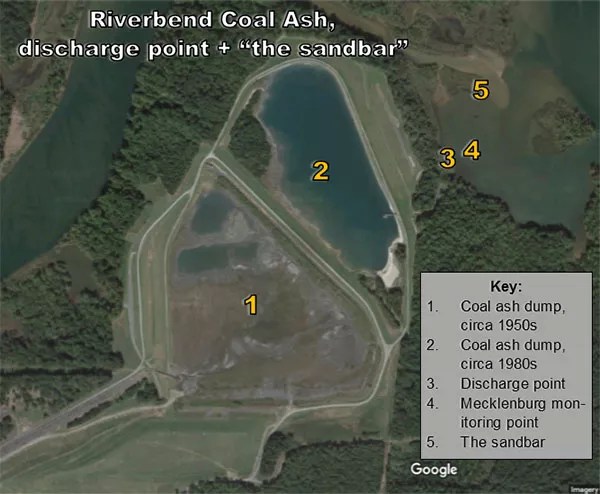
The thing is, that cove is adjacent to “the sandbar,” a popular summertime hangout.
Still, Charlotte Water says the water is fine. And it is; it should be. I mean, I can only go by what they report, and they say there is no arsenic in your drinking water.
Hey, they drink it. I drink it. We’re in this together. Right?
This article appears in Jul 21-27, 2016.


Whatever high school intern wrote this story is lying about where the sandbar is actually it is at least another 1000 feet north out of that tiny picture but I guess nobody cares if you complain about environmental stuff
So if you were swimming 1000 more feet away from where i dump acid into the water – tell me genius, are you going to keep swimming? Your logic is childish to call out something so trivial. Do some homework you sped case. Gosh, I hate uneducated dumbasses like you – use google you moron there is no excuse in this day and age for being so stupid!
That’s not the point chubs. The point is this is supposed to be a reporter or at least someone that is educated but it’s convenient to stretch false things and misrepresent facts if it fits the goal . But I’m cool to go back and swim there and I’m sure hundred or so of us will be out this weekend and the city says it’s safe so go ahead and come out . Meet us at the spot on this map first tho so you can see what a dumbass peice of shit this story is ok
Rhiannon is a seasoned environmental journalist. She is founder, producer and director of the documentary Coal Ash Chronicles and is known as the Coal Ash Queen. So yeah, I’d say she’s pretty much an authority on the subject matter. #Bye
Dear readers,
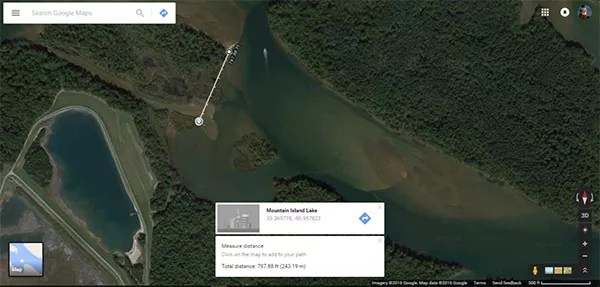
I would like to thank Sam P. for pointing out the error on the map. After speaking with some folks who recreate on the sandbar, I have created a new map that I’ve asked Creative Loafing editors to run as a correction when they return to work on Monday. (If I could post it in this comment, I would.) The point on the map where those people say they hang out is, according to Google Maps’ measuring tool, 797 feet away from the #5 marker on the map in the article.
As someone who also hangs out on the lake, though not on the sandbar — as Sam P. pointed out, I don’t seem welcomed there — I have witnessed people recreating in the area of the #5 marker and have video footage of people hanging out there. I have also encountered several fishermen in that cove on several occasions.
My goal as a journalist is to inform, not to do any of the negative things Sam P. suggested. I am always happy to correct an article when warranted and welcome future correction suggestions.
With that, I will say that I am disappointed by the tone of Sam P.’s comments and the other accusations that he made which are unwarranted and mean-spirited. And, to correct him, the city has only commented on the treated drinking water, not on the safety of the sandbar or the sediment in the lake. To my knowledge, no one from the city, county, state or federal government is studying the sediment in the lake or the composition of the sandbar.
What I think would be good is if both NCDEQ and independent researchers conducted studies at the sandbar to clarify this issue.
Best regards,
Rhiannon Fionn