


The mood was a somber one at Progress Park on September 15 as approximately 75 people gathered to mourn Al Gorman, who was struck and killed by a car involved in an auto accident while riding his bike down Parkwood Avenue at the intersection of Hawthorne Lane just days before.
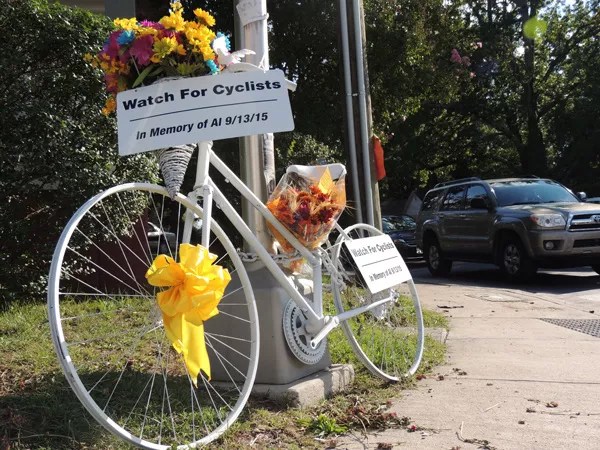
The turnout was a good one, and perhaps surprising, considering most of those in attendance had never met Gorman.
Gorman, 73, lived nearby in the Belmont neighborhood, where he had recently began living in a home with roommates after struggling for many years with homelessness following the death of his wife from cancer. He was known by many throughout the city, if not by name then by those who would see him on a regular basis riding his bicycle around different parts of the city.
One of my earliest memories of Charlotte was seeing Al on his bike almost daily, traversing between Family Dollar and other spots along the Sugar Creek corridor where I grew up. I spoke with him a couple times at a McDonald’s I would often walk to from my house as a young teenager, and it was quickly apparent he was one of the sharpest, most erudite people you could speak with. He always had a newspaper in his hands and his bike was never far away.
It was that bike which drew a connection between Gorman and many of those who attended the vigil at Progress Park. Save for a few friends, most came because they were members of the cycling community, and shared that bond with Gorman. “That could’ve been me,” was a thought often expressed by cyclists in the week after the accident. Following the vigil, cyclists took a silent, three-mile ride around the Belmont and Villa Heights neighborhoods, ending where the accident happened, on a stretch of road many in the cycling community believe to be the most dangerous stretch for pedestrians and cyclists in Charlotte.
But first they spoke about Al and the changes they want to see in bike infrastructure on Charlotte’s roads.
“Many of you say, ‘Did you know Al? I lived a block and a half away from Al, and I did not know him. However, I’m a part of the human race, I’m a cyclist, I’m a bike commuter, I cross over Parkwood and Hawthorne daily, and because of that I thought it was important that we get together and do this.”
— Dianna Ward, founder of B-Cycle Charlotte
Cyclists say Parkwood Avenue allows for driving at speeds well above what is safe for a residential area. Front porches line much of the street, especially in the area near Hawthorne Lane. That intersection alone has seen nearly 200 accidents involving pedestrians in the last five years, according to the Transportation Choices Alliance.
“It’s a speedway,” said Dianna Ward, who organized the vigil. Ward is the director of Charlotte B-Cycle, a successful bike-share program in Charlotte, but her connection to this issue came at a much more personal level. She was not far behind Gorman on the day he was hit and was one of the first people to arrive at the scene of the accident. Speaking with her about that day, it’s evident the experience has affected her greatly.
“People are treating (Parkwood Avenue) like it’s a thoroughfare, like it’s Wilkinson Boulevard, except it really is going through dense neighborhoods. That’s one of the challenges,” Ward said. “I’ve almost been clocked right there at that corner by people turning left (from Parkwood onto Hawthorne). There’s just a lot going on at the intersections. There are some easy fixes for things they can do and they’ve got to slow traffic down on Parkwood. It’s unfortunate that it took Al to start having this conversation.”
Close calls are a normal thing for cyclists in Charlotte, and that’s when they’re lucky. The 140 bicycle accidents reported to CMPD last year were the most in over a decade, as more people take up biking as an alternative form of transportation and residents with cars continue pouring into the city. Almost every cyclist I spoke with following Gorman’s death had been hit at some point, and rarely had they ever reported it. Most cyclists don’t report an accident involving a vehicle unless there’s a serious injury.
“Most aren’t reported because they’re not bad,” said Kevin Kennedy, owner of The Spoke Easy bike shop in Elizabeth. “Drivers obviously don’t want to hit people, but just about every situation is distracted driving. There’s a pretty good correlation. Almost any time someone almost hits me or buzzes me, I can see them saying ‘Sorry’ while still holding their phone to their ear.”
The “car versus bike” arguments are ones that most cyclists are familiar with, and have become weary of. There’s a widespread feeling among the cycling community that arguments with people who don’t believe cyclists belong on the roads – arguments that often break out on social media sites ¬– have become counter-productive. The real change they hope to see will come from the advocates on the ground and those in the city that they believe want to help.
“I’m asking you all to be more cautious while driving. Imagine that a biker you see is me. What would you do without all the greatness that is me? As you ride by me, from here on out, imagine the greatness that I have and be cautious so others will be able to enjoy the greatness of someone they love as well.”
— Lakeirra DeSean Booth, “Shero” with Black Girls Do Bike Charlotte
Many of the neighborhoods surrounding Uptown — the NoDas, Plaza Midwoods and SouthEnds of the city – don’t pose much of a problem for cyclists. It’s getting from one of these neighborhoods to the next that poses much of the risk, cyclists agreed. The site of Gorman’s death, for example, lies just between NoDa and Plaza Midwood, both of which are home to many cyclists.
Ann Groninger, lawyer and founder of Bike Law North Carolina, said traveling from Uptown to NoDa is a popular ride but has become difficult in recent years.
“It’s tough to get there. You can use the greenway, which is not optimal because it’s kind of deserted, or you can use North Davidson Street, which is not good for bikes; a skinny little road with a lot of traffic and now construction,” Groninger said.
“I’d like to see some of the streets that are commonly used by cyclists and pedestrians — Parkwood is obviously one of them — to become more bike and pedestrian friendly by slowing speed limits or putting in more stops. Make them more of neighborhood connectors rather than arteries. There are good options to get to some places but there are a lot of places that are just hard to get to,” she said.
Numerous advocacy groups in Charlotte are in constant talks with city staff about ways to improve safety issues for pedestrians and cyclists in problem areas, and many feel the city is open to helping fix those issues. But with so much growth in Charlotte over the last decade, it’s hard to keep up with infrastructure needs. There’s also some disagreement in the community about what improvements should be made. While some welcome more bike lanes, others say they don’t feel safe in the ones that already line some streets, like Elizabeth Avenue.
I spoke with a group of cyclists who use their bikes for work Uptown, including a food delivery cyclist and a courier, and each said they won’t use bike lanes in the city.
“When you’re in the bike lane you’re not necessarily in the line of sight for vehicles,” said Chris Daily, who doesn’t work on his bike but rides Uptown almost daily. “If I use the bike lane, I’ll merge into it to let people go around, then I get back in the road. It lessens your chances of getting run over because people are texting and talking and they’re not paying attention to what’s going on on the side of the road. You want to be in front of them where they’ll see you”
Mickey Nash does courier work Uptown and said Elizabeth Avenue can be one of the most dangerous spots for riders, especially in front of CPCC, where bike lanes were implemented in road construction that brought the new Gold Line trolley tracks. Nash said the bike lanes are more dangerous than the road because police cars often park in them or people use them to drop off students in front of buildings. The road can be just as bad, as a tire can easily stick into the new tracks if cyclists aren’t careful. Nash learned the hard way earlier this year, flipping over his handlbars after getting his front tire stuck in the track.
“I’m missing two teeth from that bullshit,” Nash said. He still insisted the bike lanes near Uptown aren’t a safer alternative, however.
“I’d rather somebody see me and yell at me for being an asshole than not see me and kill me,” he said.
As I chatted with the cyclists hanging out at The Spoke Easy a man named Dread, the store’s service manager and architect at Cluck Design Collaborative, which Kennedy runs out of the same Elizabeth Avenue building, began work on an orange bike that he said had been hit by a car along with its rider on the previous day. He said it’s a normal thing he deals with and that most go unreported.
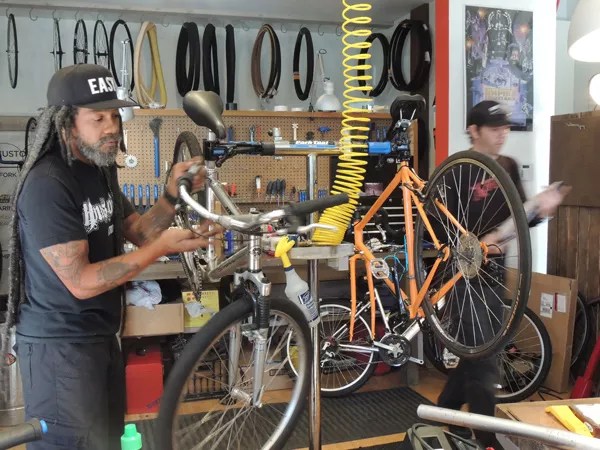
“The major issue for most of us commuters is just getting the word out to share the road and how cyclists have a certain right to the road just like they do,” Dread said. “We get a lot of honks and screams to get out of the road, people zoom past us and don’t give us a clear path as they go around, they block us at intersections. I think we’re seeing a lot more accidents and that’s just because of the population, that’s just numbers, I don’t think aggression has increased.”
He said the culture has changed for the better since he began biking in Charlotte in 1999, at which time there was no culture or infrastructure.
“Every year there’s something new or something good happening for the cycling community. The word is getting out and people are definitely listening,” Dread said. “A lot of people, like Dianna, are out there doing the footwork for us. We definitely have a good strong community here.”
Kennedy agreed the advocates in the community are doing great work to help push city leaders to build more infrastructure, but he doesn’t feel the city can keep up, or cares to as much as they say they do.
“There are a lot of advocates and I think the city wants to do things in general, I just do think that it’s a low priority for them,” Kennedy said. “It’s hard not to get into the car versus bike argument. That gets really emotional and it seems not to be as productive. As architects, we do projects that involve parking and most of our lives consist of trying to figure out how to park cars. That’s just a part of our modern life is the car.”
Groninger believes getting more cyclists to actively call for change would help move the city along to act on requests.
“The advocacy groups are usually the most vocal and active,” she said. “There are so many recreational riders in this area and some are involved but so many aren’t. The numbers of cyclists really outweigh the types of cycling groups that we saw at the vigil. We need to figure out a way to get those groups motivated and pull them into the discussion. They benefit from others getting involved and speaking for them and some of those groups do a lot as groups, but I think getting more individuals involved would be great.”
“Do you remember Horton Hears A Who? That one little Who couldn’t make his voice heard and nobody believed that they were there. So they got all of their friends and neighbors and everyone to shout, and finally when they were all shouting the same thing, they were heard. They weren’t saying, ‘We need bike lanes, no we don’t need bike lanes, we need to be in the lane,’ everybody just said ‘We are here, We exist. Recognize us,’ and they survived, and that’s what we need to do.”
— Ann Groninger, founder of Bike Law North Carolina
One long-time member of Charlotte’s cycling community who will now be on the front lines of advocating for friendlier bike infrastructure in Charlotte is Jordan Moore, recently named as bike program director at Sustain Charlotte, where he will work for the next two years to help communicate the cycling community’s needs to city staff. He said the Charlotte Department of Transportation has plenty of bike-friendly people on board, and he’s hopeful they will help take Charlotte to the next level.
Moore said he wants to see an increase in the amount of people commuting to work on bikes as opposed to just riding on the weekends.
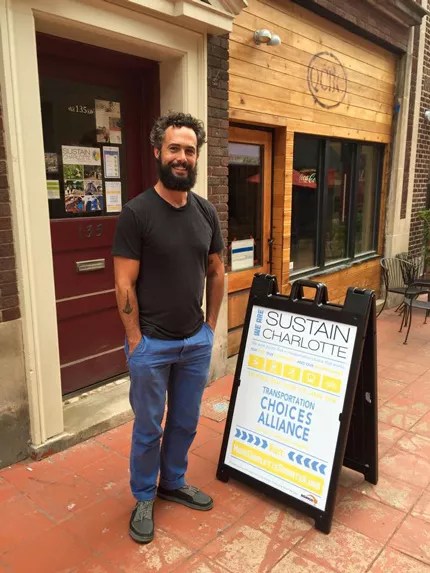
“Most of the people in Charlotte’s cycling community are still behind the wheel of a car,” Moore said. “The Charlotte cycling culture is exactly like Charlotte; we’re waiting to identify ourselves as more, as better. There are believers, there are people who are great riders, but overall, can we look at somebody and say, ‘Get out of your car and ride with us?’ That’s a tough sell. This is why I’m here.”
He said he’d like to see Charlotte model itself after towns like Sevilla, Spain that have implemented bicycle infrastructure and seen their cycling population grow exponentially as a result. He says his vision is for Charlotte to become “the Copenhagen of the South.”
“In the last 10 years, CDOT’s really changed,” Moore said. “They’ve put their focus on bicycling and pedestrian activity, but now would be the time for Charlotte to emerge as the complete leader in bicycle infrastructure. More people are not wanting to drive. It’s a terrible experience. A lot of people say driving in Charlotte is one of the worst experiences they’ve had. In light of correcting that problem, let’s throw in this huge model of connectivity that gets people out into the neighborhoods and where they want to go without having to burn gasoline.”
Moore said he will push for road diets, in which the numbers of lanes designed for cars on thoroughfares is reduced to make way for separated bike paths that run parallel. He said the work should begin on Parkwood Avenue, where it’s connection to the next installment of LYNX Blue Line track can make it a hub of connectivity for cyclists and pedestrians. He said the car vs. bike argument “doesn’t exist,” because cars will always win, and that’s why it’s important to create separate infrastructure.
“It’s been said that Al could have been any one of us, which is true. Al could have been a lady with a stroller, Al could have been a man walking his dog. Al was a pedestrian trying to use a thoroughfare,” Moore said. “It’s equally true that any one of us could have been the guy driving that Ranger.”
Nathaniel Lancaster was charged with misdemeanor death by vehicle for starting the wreck that killed Gorman. Lancaster’s Ford Ranger hit a Lexus when he was turning left onto Hawthorne from Parkwood. The Lexus went off the road and struck Gorman. Lancaster’s friends have pointed out that he also cycles regularly around the city, and Gorman’s death was a freak accident.
“Any one of us could have been the guy driving on that road because of how it’s set up,” Moore said. “As a motorist you’ve got to drive fast, you’ve got to bust through the lights and get around people and because of the speed and the inefficiency of that road, any one of us could have been that person whose life is changed dramatically. No road should function like a pinball machine, where the humans are in the middle of it and might get hit by the metal ball.
“What we need to do is admit that we cannot have thoroughfares where mistakes are that deadly,” Moore said. “Central Avenue, 7th Street, South Boulevard, North Tryon into Uptown; anything that’s within three miles of the Uptown corridor should be 25 miles per hour. You would never zip your car down the main drag of North Davidson Street at 55 miles per hour; they’d kick your teeth in. You would not get away with that. But somehow, [on Parkwood Avenue] we’re letting people get away with it. I say, ‘Hell no.'”
As I wrapped up my conversation with Dianna Ward in Elizabeth, a CDOT representative happened to walk by on his way to an operation for Watch for Me, a CMPD and CDOT program that focuses on pedestrian safety. The representative, who did not want to be quoted at that time, made a remark about the tragic circumstances of Gorman being in the wrong place at the wrong time.
“I don’t like that expression,” Ward responded. “There should never be a wrong place or a wrong time for cyclists.”
Related Stories

Pedal to Porch Puts the Spin on Gentrification
This article appears in Sep 23-30, 2015.
Nice, thorough article, Ryan. It’s good to read about the progressive thinking regarding transportation in this city. I especially like Mickey’s quote about being an alive asshole.
Not to detract from the cycling focus here, but I think Jordan makes a good point when he says Al’s death could have been a stroller-pusher or a dog-walker. I disagree, though, with his assessment that drivers have “got to” drive like dicks. It’s strange how getting behind the wheel turns a sane person mad – everyone’s seen it – there’s a special anxiety about time when driving. Each driver can make a conscious decision to respect life – drive the speed limit, stop at red lights, don’t accelerate through yellow lights. Tell yourself you’re doing it in an effort to be a better person. Be above the time-crunch paradigm. Almost every driver has been guilty of it, but we can be better going forward.
First, Ryan this is great writing. I appreciate your detailed coverage, going beyond the surface issue and getting a broad set of opinions.
Second, Parkwood is an excellent example of how bad things can be for a pedestrian or cyclist. I cross Parkwood every day either commuting to work on bike or walking my dog in the neighborhood. It is unbelievable. 55 is the new 35; it is like a 4 lane highway at 830am. A half baked solution is not the answer here, we need dedicated lanes and drastic lowering of the speed limit along with strict enforcement. In NC if someone is going 15mph over the speed limit and traveling in excess of 55mph it is mandatory that they lose their driving privledges. This is how dangerous the state finds those conditions to be for us, the other drivers and people. It happens every day on this road.
Third, how are all of the people using the BLE crossing these roads, especially as we grow denser in the center city area and neighborhoods. We will build a train we have to drive to. That’s not the idea. That’s not what we want Charlotte! We want to be better than Atlanta from both a traffic and pedestrain/cyclist perspective. To do so we can’t follow the pack, as Moore is advocating this is the time to be the lead on how America commutes in the southeast. Nobody has ever said “driving my car for the rush hour commute this morning was so great”. Throwing more lanes and parking spots won’t ever change that. Think about it.
Great to see some serious writing and critical thinking from CL again!!! It has been a long time since we’ve seen such. Keep it up!!
I’ve came across this Article because a few nights ago me & my mother saw a ghostly shadow like figure in the sugar creek area around 11 o clock pm the figure was on a bike (with no reflection from our lights you could not see the rims or any features of the figure) riding along side a train where they are currently doing construction. The figure rode along the drivers side where my mom was close to the car and disappeared (i didn’t see it but she saw it and it frightened her) and reappeared in the middle of the passing train.. rode alongside and disappeared again. i was wondering if the person died on the tracks but i found not articles relating to a cyclist or train death other than this article considering this man rode in that area it could’ve been this popular cyclist. I’ve heard if you keep a significant item of a person who died in a traumatic way they get trapped between worlds & wander. RIP to this gentleman i hope his spirit finds its way.