


On a warm, lulling Sunday afternoon in late October, the Barnettes’ black sedan halts sharply in front of a blue bungalow home in east Charlotte and out pop the girls in long pants. They seem to be the only people in Charlotte too busy to notice the day’s midsummer feel. The Barnettes have skipped out on church early. Daddy Barnette, a minister, pardoned them. Their family band takes priority in an already-packed Sunday schedule. Church. Brunch. Practice all afternoon. Band meeting. Then Kristen and brother Rufus are off again to colleges in Winston Salem and Greensboro, respectively. It’s a normal weekend.
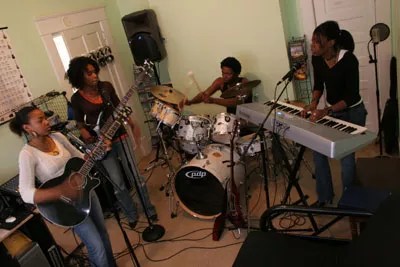
Today the Barnettes have to cram in an interview and then start prepping for their big break. The siblings are taking their act to the next level: an early December audition with Mallet Records, a jazz and R&B label in Atlanta. At the Midatlantic Music Conference in Charlotte a month earlier, Mallet owner Jason Taylor had fawned over the Barnettes, and now he wants to hear them try a Latin/Caribbean sound, a completely foreign genre to the quartet.
It’s only been two years since Elesha strolled into a guitar store and made her first $299 band investment: a black Ibanez electric guitar. She had never played guitar before but had grown up, along with her siblings, performing classical music — she on cello, Adrienne on violin, Kristen on viola and Rufus, “the little drummer boy.” The siblings admit that playing classical instruments wasn’t always their first idea of fun. Each child had a practice log, which their parents made them sign to ensure they rehearsed long enough. The four children toured the area on weekends playing classical music at small, formal gatherings such as bank receptions — not exactly the typical breeding ground for inspired rock & roll.
“You couldn’t really jazz up those instruments,” says Adrienne.
“And you can’t sing and play the violin,” adds Elesha.
What put Elesha in the guitar store in 2003 was her need to reclaim some creativity in her postgraduate life. Her day job at Proctor and Gambol, selling wholesalers on the hydration quality of shampoos, was not exactly the stimulating outlet she was used to at UNC Charlotte. The year before, Elesha had directed her own full-length film. Her friends and family encouraged Elesha to continue in media arts, but after meeting musicians when she was compiling the sound track for her film, she had another idea. She wanted a band.
It didn’t take much convincing for her siblings to jump on board. The second edition of the Barnettes formed. In less than half a year, Elesha, Adrienne and Kristen taught themselves new instruments and managed to practice enough on weekends (along with Rufus on drums) while attending separate schools during the week. Giving up weekends for the band means giving up the time most kids spend socializing. But the Barnettes are used to spending time with each other.
The Barnettes are not the only set of siblings who have stuck together for love of music. From alternative teen rockers Justincase to R&B megastars Jodeci, prominent family acts seem to be a Charlotte-area specialty. And there’s more: Popular Concord-based indie-grass group the Avett Brothers and Charlotte Latin rockers La Rúa both feature a pair of brothers, as does the experimental twang-rock band the Houston Brothers. Is it Charlotte’s family-friendly vibe or just the Southern tradition of placing family above all?
Psychotherapist and performance coach Phil Towle says bands are in many ways already like families, and if a culture of love and respect is developed, a healthy group dynamic will exist. A functional family band consists of members who feel valued equally: “If Johnny is a better lead guitar player than I am, I can pick up the bass because I feel like I’m a part of something.”
To Elesha Barnette, sharing a bloodline with her band mates is a positive. “It’s an opportunity to get to know each other as adults,” she says. “Most siblings are growing apart from each other at this age.” Before the band, for example, Elesha would never have figured her brother Rufus possesses the poetic capabilities he’s shown in the lyrics to his songs, such as “These Walls.”

“It’s about a girl who’s done me wrong,” Rufus says.
What’s more, the siblings’ familiarity helps in the collaborative process. For the song “Half Way,” Elesha had written the lyrics, “I want to meet you half way.” Adrienne tweaked it a bit to “Will you let me meet you half way?” It may seem an insignificant change, but to Elesha, “it turned the song into something everyone could relate to.” Someone who didn’t know her as well as Adrienne couldn’t have sensed what Elesha was going for.
As a performance coach, Towle has worked with bands like the Barnettes as well as with businesses and sports teams. He has a Super Bowl ring from his work with the St. Louis Rams and he also helped the former members of Rage Against the Machine deal with the desertion of their charismatic lead singer Zack de la Rocha. Most famously, Towle appeared in the Metallica documentary, Some Kind of Monster. In the film, he is seen urging the rockers to open the line of communication and consider each other’s feelings.
Towle says old family dynamics are at the root of any group setting. “Our earliest stages of life are inside a family system; whether it’s functional or dysfunctional, we tend to always replicate our family dynamic. The family system, if you think about it, becomes prototypical.”
People who have been isolated or disconnected from their families tend to play the role of the survivor, says Towle. They are more self-absorbed and less willing to subjugate their needs for the sake of the group.
In a biological-family band, normal relationships are magnified. “There is a division of roles in family. There are different kinds of family — people who are more autocratic, more democratic; people who seek more control. In relationships, the same dynamics appear, they just might be a little more pronounced in a work setting. In general, the more time we spend with each other, the more difficult it becomes to separate out personal from professional.”
Christopher Strong, who toured the South with his Strong Family String Band in the 1980s, wrote in Bluegrass Unlimited about the challenges of maintaining a healthy relationship. “At the heart of the family bands lies a decision that each family must make: To what extent will we treat this as a business? Because the band is not our principle means of support, we can enjoy the luxury of treating it as a profitable hobby, and, more importantly, as an educational opportunity for our three teenagers.”
The Tosco teens know the cutthroat business side of music all too well. The music industry chewed them up and spit them out. When Justin, the oldest Tosco, graduated from Vance High School in 2001 his sibling trio Justincase hit the big time. They signed with Madonna’s Maverick label, but right off the bat the family band was fighting to meet the label’s lofty sales demands. As Justin’s friends were experiencing their first tastes of college life, he was driving in a cramped van through Nebraska playing at Wal-Marts to boost record sales.

“Every day ended up being with my family — while we were recording, living in LA and touring to support the record,” Justin says. “It was challenging because it was a different type of lifestyle than is the norm for most kids my age.”
For a guy still in his early 20s, he’s cannily reflective of the experience: “I was supposed to be a freshman in college when we got signed, which is right at the time you’re supposed to be moving away from your family and having that time of independence.”
At the Evening Muse, Justin’s father, John Tosco, is on stage, casual in a black T-shirt and jeans. He has hosted showcases three times a year at Tremont Music Hall and monthly amateur events at the Muse for four years. Shortly after Tosco’s kids learned to walk, they were performing for Dad’s friends at music parties he would throw at his home.
A House Party at the Evening Muse is the closest thing to American Idol you’ll find in NoDa. Deluded young musicians doing sloppy, loud performances and aging hippies clinging to their folk-strumming days are typical, but there’s an occasional diamond in the rough. This was the scene of the Barnettes’ first public show a year and a half ago — a 10-minute, two-song performance John Tosco describes as “rough around the edges.” Tonight, a trio of shy 10th graders has just performed a cover of a Crosby, Stills, Nash and Young song, and Tosco, the consummate music scout, was impressed: “They did a nice job. Young kids usually rush through a song.” He makes eye contact with the two girls and blond, floppy-haired boy in the back of the room: “From me, that’s a heck of a compliment. You should be proud.”

As a young man in Denver, CO, Tosco played in a band but never caught his break. He took a job in Charlotte managing a restaurant and started giving music lessons to keep his sanity. He never forced his kids into music, he says, but he encouraged them to take the deal with Maverick Records, knowing in all likelihood it would be their only chance. Justincase was marketed behind Justin’s good looks for a young MTV audience that was growing weary of boybands. The trio’s alt-rock single, “Don’t Cry for Me,” cracked the Top 10 on the network’s afternoon show TRL.
“It was a very commercial approach,” says Justin. “We were a little iffy with how much confidence we had in the game plan, but at the same time it was ‘the label knows best.'”
Maverick executives, for example, forced sister Hannah to dye a red streak into her hair, which she disliked. They suggested it would give them “alternative rock” credibility. Ultimately, the label set unrealistic goals for the teens, expecting them to hit it big quick like their dime-a-dozen boyband predecessors. But Justincase played rock, and rock bands are normally given a longer timetable and allowed to focus more on developing their music and slowly building sales.
Nick and Hannah Tosco spent most of their high school years taking correspondence classes over the Internet. Justin says none of them regret signing the deal, but for a family that played music every day growing up, the current level of musical inactivity would have been unthinkable a few years earlier. Nick and Hannah don’t play regularly anymore, and Justin only performs at small venues in Chapel Hill, where he goes to school. He is unsure whether he will pursue a professional music career again.
Practice begins. The Barnette girls have changed into jeans. The beads and pendants dangling from their ears and necks match their tops. Rufus, in typical guy fashion, drags his feet on the carpet as he enters in what remains of his church clothes — gray slacks and a black tank top. Elesha comes in last and trips over the door, nearly wiping out. Two years of playing in the same tiny green room, one would think she would know every inch by heart — there aren’t many to memorize. But the room is that cramped.
The Barnettes first album, Four Green Walls, is named after this room. “I just really like green,” says Elesha of her paint selection.
“It’s ninja-turtle green,” Rufus says.
“Nah,” Elesha scoffs. “It’s lighter than that.”
In front of the first lime-green wall, on the side with the door, is a desk and a computer that records their music. Three bookshelves stack up to the ceiling: books on the first two shelves (including All You Need To Know About The Music Business) and stuffed animals on the top one. The second wall, at the end of room, is one big window. Adrienne points to it and says, “I feel sorry for our neighbors.”
Over the third wall, across from the desk, is Elesha’s framed photography — mostly head shots of friends — hanging above a black futon. And in front of the fourth wall, taking up the bulk of the room, is the band, scattered around amps on the bruised, gray carpet that looks as if an elephant has trampled across it.
Adrienne starts the practice with an original song, “Lost.” She finds her audience, a reporter and a photographer sitting on the futon, and makes her way across the room. With three carefully placed steps around chords and equipment, she reaches the other side of the room and drops to her knee, her hands controlling the long bass guitar. Tall and skinny, with the bass strapped across her chest, she looks like a human plus-sign. Her frizzy curls are mini Slinkies, bouncing on separate planes. “Paul Mitchell is my friend,” she says of her locks.
If Elesha is the calculating brain behind the band, Adrienne is the pulse. Even in practice the band feeds off her energy, which is why she leads the Sunday marathons. “I like to entertain,” she says. Her foot taps against the ground and the room shakes a little extra. The rest of the Barnettes pick up the tempo.
Adrienne chooses an Otis Redding cover, “Hey, Hey Baby” and the band gives it their Barnette twist. The intros are long, building an anticipation before the song reaches its destined pace. Each instrument comes in separately and takes a roundabout path before dropping into place. Elesha says this distinct style comes from their classical music background. As a result, their songs are more complex than most pop songs. Bass lines change, and shifts bring the songs back to the beginning.

During “Hey Ya,” a cover of the OutKast hit, Dad walks in and dances by the door. He comes back three more times. “We have two Joe Jacksons,” Rufus jokes, referring to the Jackson 5’s notorious stage dad. The parents are supportive, even if it means losing sleep. Elesha has woken her mom at 1am because she was so excited about a breakthrough she made on a song.
Adrienne and Kristen rock out in braces, Rufus looks up awkwardly at the camera when the photographer approaches for a close-up. He asks if the band can have a copy of the photographs for their Web site. The photographer politely tells him she does this professionally, and it takes him a second to realize that means the photos would come at a price. The Barnettes’ soulful harmonies might be the only part of the group’s act not in its adolescence.
Their sound is a mix of rock, pop and soul with a trace of a Southern sensibility. “The way I sing, some songs have a little hint of a drawl to them. It’s not a country twang, it’s just a little bit of a drawl,” says Elesha.
The prevalence of family bands in Charlotte may be more than just coincidence. In the South, a special relationship exists between family and music. During the antebellum period, string music thrived in the Piedmont. Music was the central means of entertainment, and rural families incorporated it into their lives on farms. Frolics were organized around tobacco curings and corn shuckings, where music was a tool to alleviate boredom. Medicine shows predated concerts in the South. The best musicians in the area would play at those festivals, and most of the townspeople and farm families would attend them.
From those jams arose the early country music advanced by pioneers such as the Carter Family, the Stanley Brothers, the Louvin Brothers and other pickin’ families. By the late 1960s, just after the first wave of rock & roll, Southern rock blossomed across the region. The Allman Brothers, pioneers of the new sound, brought with them a renewed emphasis on kinship. The Allmans viewed their entire act, from the musicians down to the managers and groupies, as part of a collective family.
Groups like the Marshall Tucker Band, the Charlie Daniels Band, Wet Willie and Lynyrd Skynyrd followed, and although lacking actual blood relation, they picked up on the familial vibe. Following in the footsteps of Charlie Pool and the North Carolina ramblers, the Allmans challenged racial attitudes of their time, playing mixed-race music and traveling across the segregated South as a mixed-race family of musicians.
Scott Avett of rock-influenced string band the Avett Brothers thinks race was a factor in creating Southern rock’s solidarity. “All those guys getting in a big car and touring around like we do now, in a little bit more of a primitive way, I imagine a lot more trouble went down,” says Avett. “There were probably more boundaries that needed to be crossed. That made them closer. It comes across in the music.”
There is a special warmth, Avett says, among Southerners. “The South probably does produce some of that vibe, whether they’re an actual family or not,” he says. “Maybe it’s because there’s more empty country, more space, I’m not really sure why.”
To the Avetts’ third member, nonbrother Bob Crawford, playing at the big, family-like bluegrass and Americana event Merlefest, held each year in the Carolina mountain town of Wilkesboro, was a life-changing, inspirational event. “Everyone was real friendly,” Crawford says. “The whole vibe of the day was just awesome.”
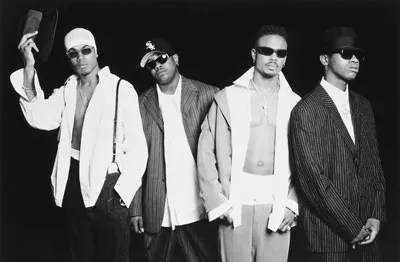
The Reverend don Degrate knows about awesome, life-changing, inspirational phenomena. He’s made more than 80 albums of music in his career, although none have hit the pop charts. Degrate is a gospel artist who is recognized on the streets of Charlotte almost every day. And yet, to the mainstream music world, he’s most famous for his offspring, Devante and Dalvin Degrate — one-half of the early-1990s R&B outfit Jodeci.
One of the biggest acts ever to come out of the Queen City, Jodeci exploded onto the music scene with their 1991 debut, Forever My Lady. The album shot to No. 1 on Billboard’s R&B/hip-hop chart and No. 18 on the regular pop chart, and it produced three No. 1 singles, including the sexy romantic ballad “Come and Talk to Me.” The Degrate brothers, along with brothers Cedric “K-Ci” and Joel “JoJo” Hailey, were instantly at the forefront of pop music. Today the group is cemented in the public zeitgeist as a raunchier version of Boyz II Men.
Considering the religious upbringing of the two pairs of brothers, Jodeci’s leap of lasciviousness was shocking. When the band was still based in Charlotte, the Rev. Degrate remembers girls waiting outside his sons’ house for hours if they weren’t home. They would make lewd comments, even though some of the girls knew Degrate was a minister.
“When I was young, a girl made you beg for it, no matter what,” the reverend says. “These girls would do it anyway you wanted. Up. Down. Front. Back. In. Out.”
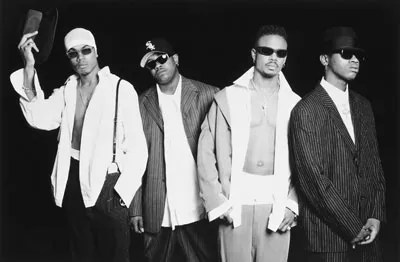
“People called them the black Beatles,” says brother Derek Degrate, who never strayed from Christian music and is in the process of making a contemporary Christian album entitled The Other Brother. The other brother has been asked a million times if he would have joined Jodeci had he been offered the chance. He says no. “God put me here to be a light for them,” says Derek. Whenever his brothers have a spiritual question, they go to him for the answer. And his presence at parties tempers their wild behavior, he says.
Derek is not always around, and his brothers’ wild behavior is not always tempered. The reverend stiffens up on that subject. Jodeci’s had more than a few run-ins with trouble, including an alleged sexual assault. The group has been saying they plan to reunite; Jodeci’s last album was 1995’s The Show, The After Party, The Hotel. K-Ci & JoJo went on to enjoy success as a duo, but Devante’s behavior is rumored to be the big factor preventing a full reunion.
“A great many pressures come with being famous,” says therapist and performance coach Towle. “Stars are constantly getting intoxicated with the adoration of external validation. Anyone who is revered has a bigger sense of themselves than they ought to because the reverence is coming not from who they are but from what they do. Fame can’t make your boogie men go away.”
Out of this distorted sense of self-worth, normal personalities cease to grow, says Towle. Celebrities often turn to sources of immediate gratification to fill the void: alcohol, drugs, sex. Their behavior is not only permitted by society, but it is almost expected. “You don’t see businessmen at conventions throwing chairs out the window or trashing their hotel rooms,” Towle points out.
The content of the music, Towle believes, attracts specific kinds of people.
“Different genres have different voices that speak to different issues,” says Towle. “Heavy metal speaks to the pain and the angst of life. There are certain things if you look at the different genres of music, you can figure out what kind of personality would be drawn into that kind of music.” Critics of some contemporary R&B and hip-hop often point to the vapid lyrics and gratification-seeking content.
Fame doesn’t corrupt every celebrity. Towle has worked with some stars who successfully maintain a healthy perspective and use their fame to improve society. Former Rage Against the Machine and current Audioslave guitarist Tom Morello, for example, constantly undertakes projects such as fighting against poverty and advocating for social justice.
The Barnettes have not quite reached Morello’s level of fame, but the family band’s December schedule looks as if they are more interested in winning Humanitarians of the Year than a Grammy. On the 19th, The Barnettes played at Children’s Hospital and on the 20th they played two shows at the Barium Springs home for Children. The siblings were bummed out when a women’s shelter didn’t return their calls about playing a free show there, too.
The day before the Barnettes were to head to Atlanta for the audition, they got a call from Mallet Records. The company cancelled the audition, citing an unspecified emergency, and did not reschedule. Kristen and Rufus had already skipped school in preparation for the mid-week audition. But the band wasn’t terribly disappointed. Elesha admits the label handled the siblings unprofessionally.
“We got a new song with a whole new sound that we really like,” she says. They also discovered a new method of songwriting. In every other song the Barnettes have written to date, Elesha and Adrienne compose and record the music and then give Kristen and Rufus a CD to take back to school, where they add the keyboard and drum parts. Since Caribbean music is a more beat-driven sound, they reversed the chain of events for the new song: Rufus and Kristen collaborated to give the song its drums-and-bass core.
Mallet Records had expressed interest in changing the band’s name from the Barnettes, implying that the company didn’t want to promote the blood ties. The Barnettes believe their cross-generational family appeal is their most marketable asset. At the September music conference, they wowed a crowd of mostly hip-hop artists. Earlier that same day, at ImagineOn, they got kids and parents dancing and singing along to their music. In January, the band will perform to a college crowd at UNC Charlotte. But the family image is risky: In the current R&B world, a clean, family appeal is unheard of.
On a recent trip to the supermarket with her mother, Elesha was dressed down in scrubs. Across the checkout line, a shopper stared at Elesha and she sensed the stranger recognized her.
“My mom wants me to get dressed up now whenever I go out,” says Elesha. But Rufus disagrees. “That’s not right. You should be able to dress however you want.”
A family will always be a family, rock stars or not.
Also see:
- Jodeci Dad: Come & talk to Thee
- Latino blood is thicker than agua
This article appears in Dec 21-27, 2005.