


(View From The Couch is a weekly column that reviews what’s new on Blu-ray, DVD and Streaming. Ratings are on a four-star scale.)
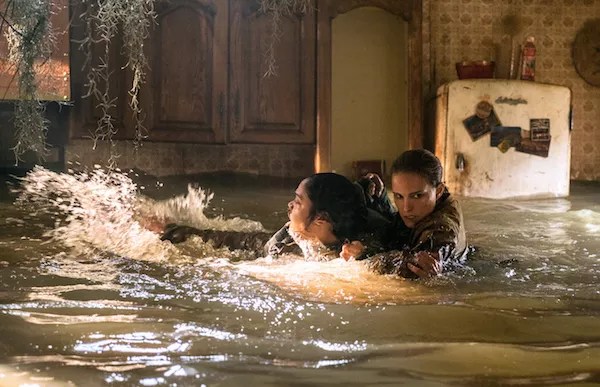
ANNIHILATION (2018). With a framing structure that lays out clues as carefully as Hansel and Gretel with their bread crumbs, the latest from Ex Machina writer-director Alex Garland (loosely adapting Jeff VanderMeer’s novel) centers on Lena (Natalie Portman), a biology professor whose soldier husband Kane (Oscar Isaac) mysteriously returns from Area X (aka The Shimmer), a vast swatch of stateside territory that has been taken over by an alien presence. Kane quickly lapses into a coma, thereby inspiring Lena to join the latest team entering the forbidden zone. But immediately after penetrating The Shimmer, Lena and her colleagues (Jennifer Jason Leigh, Tessa Thompson, Gina Rodriguez and Tuva Novotny) encounter death and destruction — or should that be self-destruction? Although the film’s motives and meanings are in constant flux, an indisputable theme involves inward annihilation, whether of people, places, or the planet itself. To reveal specifics would be to traffic in spoilers, but suffice to say that Garland pulls no punches in either his metaphysical musings or in his visual extremities. Science fiction cinema often borrows from itself, and Annihilation seemingly draws from such various genre signposts as Ridley Scott’s Alien, John Carpenter’s The Thing and perhaps even Andrei Tarkovsky’s Stalker. Yet certain images – some grotesque, others gorgeous – prove to be uniquely the film’s own. The aura of unease maintained by Garland dissipates during a busy climax, and the nature of the final shot was pretty much telegraphed by the picture’s halfway mark. Yet even here, the existential implications outweigh the physical evidence — come to think of it, it’s really the only way a movie of this nature should end.
Blu-ray extras consist of a multi-part making-of piece that examines the characters, the visual effects, the set design, and more.
Movie: ***
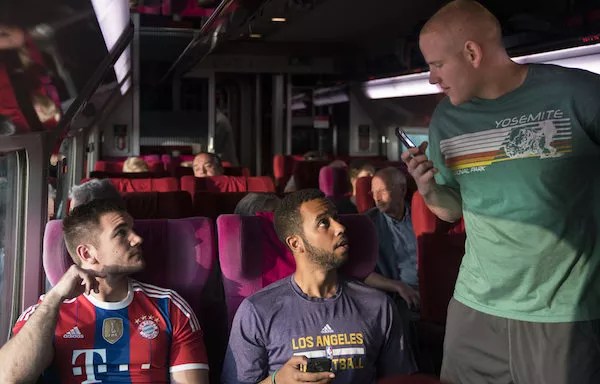
THE 15:17 TO PARIS (2018). Clint Eastwood has directed 36 motion pictures over the course of 41 years (with at least one more on the way), yet with the possible exception of the imbecilic 1977 action film The Gauntlet, none have been as painful to watch as his most recent effort. The 15:17 to Paris is based on the real-life incident in which three young Americans — Spencer Stone, Alek Skarlatos and Anthony Sadler — heroically stopped a terrorist attack while vacationing in Europe. Eastwood’s bright idea was to have the three men portray themselves, but since they all prove to be wretched actors, it’s a gimmick that backfires spectacularly. Amazingly, though, these cringe-inducing performances aren’t the worst part of the picture. The first third devotes much of its time to the trio as young boys, and this section is shockingly devoid of the consummate professionalism found in every previous film helmed by Eastwood. Instead, these scenes feature the chintzy production values and ham-fisted dialogue (courtesy of scripter Dorothy Blyskal) generally reserved for faith-based flicks, and the boys cast as the young Spencer, Alek and Anthony arguably turn out to be even worse actors than the grown-ups. The middle section, which finds the grown men hanging out in Europe, is little more than a snooze-inducing travelogue. Only the scenes involving Moroccan terrorist Ayoub El Khazzani (Ray Corasani) and his thwarted assault aboard the Amsterdam-to-Paris train convey any sense of genuine drama. The takeaway is that a 30-minute nonfiction piece about this incident would have been a shoo-in for the Best Documentary Short Oscar – as it stands, The 15:17 to Paris is instead one of the worst films yet released in 2018.
Blu-ray extras include a making-of featurette and a piece on the three real-life heroes.
Movie: *1/2
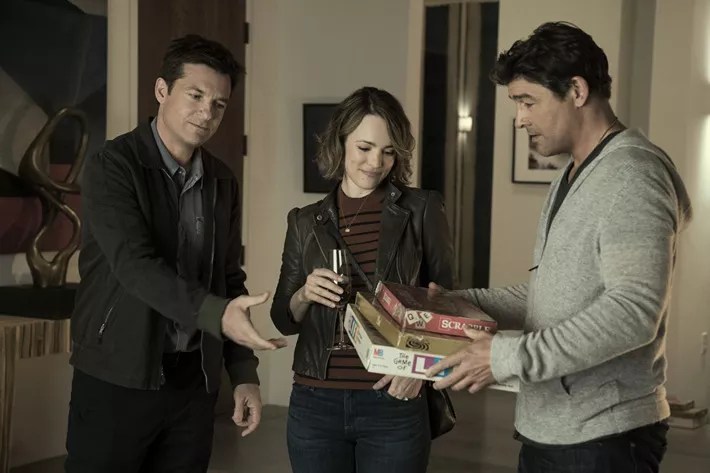
GAME NIGHT (2018). It’s no match for a marathon evening of Apples to Apples with assorted friends and loved ones, but as a date-night option, a person could do worse than Game Night. A reasonably diverting comedy that hits all the expected beats, this stars Jason Bateman and Rachel McAdams as Max and Annie, a couple who routinely invite their friends over to their house to partake in Parcheesi, charades, Monopoly and seemingly every other game this side of Spin the Bottle. Kicking up the festivities a notch is Max’s highly competitive brother Brooks (Kyle Chandler), who arranges a murder-mystery party for the gang. Brooks ends up getting kidnapped, a wrinkle that amuses the participants until they realize that the snatch wasn’t part of the game and that Brooks’ life is actually in danger. Sporting as many twists as David Fincher’s comparatively more somber The Game, Game Night works best when it focuses on the personalities of its characters and meanders when it pays too much attention to the particulars of the plots-within-the-plot (which don’t really hold up to post-viewing scrutiny anyway). Bateman and McAdams enjoy an easy rapport together, while Fargo’s Jesse Plemons is aptly cast as their next-door neighbor, a socially awkward guy who also happens to be a cop. Be sure to stay through the final credits for a capper to the running gag involving no less than Denzel Washington.
Blu-ray extras consist of a making-of featurette; a gag reel; and theatrical trailers.
Movie: **1/2
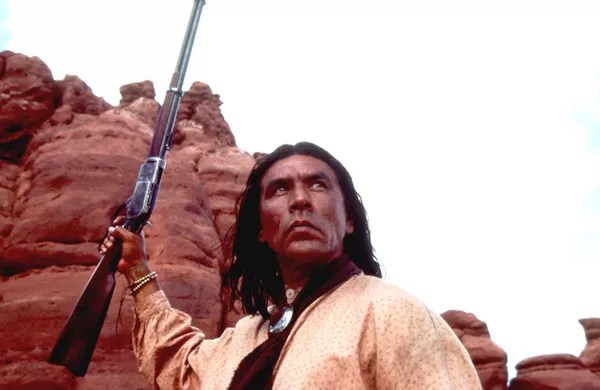
GERONIMO: AN AMERICAN LEGEND (1993). Even director Walter Hill has long admitted that Geronimo: An American Legend was the wrong title for his motion picture, since it conveys the message that the movie is, you know, actually about Geronimo. Instead, it’s yet another case of Hollywood taking a towering minority figure and shoving him into the back seat while the white guys take the wheel. Instead of delivering a fascinating biopic covering this fascinating character’s life, this barren Western instead focuses on the period (1885-1886) in which the Native American warrior (played by Wes Studi) last defies, and then surrenders to, the U.S. Army. There’s nothing inherently wrong in focusing on a single chapter, but Hill and scripters John Milius and Larry Gross rarely succeed in making Geronimo anything more than a neutered figurehead — as such, he’s largely a cypher from beginning to end. Studi, so memorable as Magua in 1992’s superb The Last of the Mohicans, isn’t given nearly enough to do, since the leads are actually Jason Patric as sympathetic officer Lt. Gatewood and Matt Damon (in only his third film) providing the narration as Gatewood’s greenhorn sidekick. A miscast Patric tackles his role as a combination of a Brando impersonator and a guy who merely needs a nap; not surprisingly, veterans Gene Hackman (as the tough yet fair-minded Brigadier General George Crook) and Robert Duvall (as veteran scout Al Sieber) fare better. Duvall’s ornery cowboy also gets off the movie’s best (most accurate?) line: After surveying the corpses of innocent Native American women and children who have been massacred by bounty hunters, he mutters, “Must be Texans. The lowest form of white man there is.”
Blu-ray extras consist of the theatrical trailer and an isolated track of Ry Cooder’s score.
Movie: **
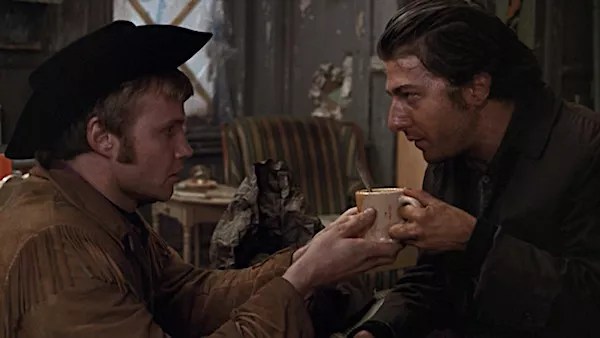
MIDNIGHT COWBOY (1969). It only takes a movie like Midnight Cowboy to point out the limitations of a rating system: How can a measly four stars convey the magnificence of this acknowledged classic, which would easily make my own short list of the 25 (15? 10?) greatest films ever made? Midnight Cowboy became the first and only X-rated film to win the Best Picture Academy Award. Over time, the rating was softened to an R, but don’t let that fool you: This is just as raw and uncompromising an experience when viewed today. Jon Voight (never better) plays Joe Buck, a Texas hustler who heads to the Big Apple intent on becoming a wealthy stud. Instead, he finds himself barely getting by on the mean city streets, with only a greasy derelict named Ratso Rizzo (Dustin Hoffman) to keep him company. Hoffman’s knockout performance is one for the history books, and the film itself scores on several levels — as a 1960s time capsule piece (dig that psychedelic party), as a still-topical examination of spirit-crippling poverty, as an experimental work, and as a study of two lost souls adrift in a concrete jungle. Added bonus: the best ad-lib in cinema history (“I’m walkin’ here! I’m walkin’ here!”). Midnight Cowboy earned a total of seven Oscar nominations (including Best Actor bids for both Hoffman and Voight, losing to sentimental favorite John Wayne in True Grit), winning three: Best Director for John Schlesinger, Best Adapted Screenplay for Waldo Salt (working from James Leo Herlihy’s novel), and the aforementioned Best Picture.
Blu-ray extras include audio commentary (from 1991) by Schlesinger and producer Jerome Hellman; a pair of 2004 featurettes on the making and release of Midnight Cowboy; 1990’s Oscar-nominated documentary Waldo Salt: A Screenwriter’s Journey; and Voight’s original screen test.
Movie: ****

NEXT STOP, GREENWICH VILLAGE (1976). Long before he became an Oscar-nominated filmmaker responsible for such hits as Bob & Carol & Ted & Alice and An Unmarried Woman, writer-director Paul Mazursky began his Hollywood career as an actor (his first credits were Kubrick’s Fear and Desire and the classic Blackboard Jungle). Mazursky recycles some of the incidents that led to his L.A. exodus in the loosely autobiographical Next Stop, Greenwich Village, a captivating slice of NYC life in the 1950s. Tired of living at home in Brooklyn with his overbearing mother (Shelley Winters) and docile father (Mike Kellin), Larry Lipinsky (Lenny Baker) decides to move to Greenwich Village, where he tries to make it as an actor while also spending quality time with his girlfriend Sarah (Ellen Greene, almost unrecognizable from her later role as Audrey in Little Shop of Horrors). The picture’s greatest strength rests in its characters: Dismissing Winters’ predictable kvetching as Larry’s stereotypical Jewish mother, Mazursky has vividly brought to life such interesting figures as the sophisticated Robert (Christopher Walken), the fiery Connie (Dori Brenner), and the gay Bernstein (Antonio Fargas, already appearing as Huggy Bear on TV’s Starsky and Hutch). The talent runs particularly deep in this picture, so keep an eye out for Jeff Goldblum (funny as a prickly actor), Joe Spinell, and uncredited bits by Bill Murray (in his film debut), Vincent Schiavelli and Stuart Pankin. As for Baker, he’s both unconventional and excellent in the central role — he would later win a Tony Award for the Broadway hit I Love My Wife and guest-star on such series as The Rockford Files and Taxi before dying of AIDS in 1982, at the age of 37.
Blu-ray extras consist of audio commentary by Mazursky and Greene; the theatrical trailer; and an isolated music track.
Movie: ***1/2
==============================
FROM SCREEN TO STREAM
(A look at a film that’s currently available on streaming services)
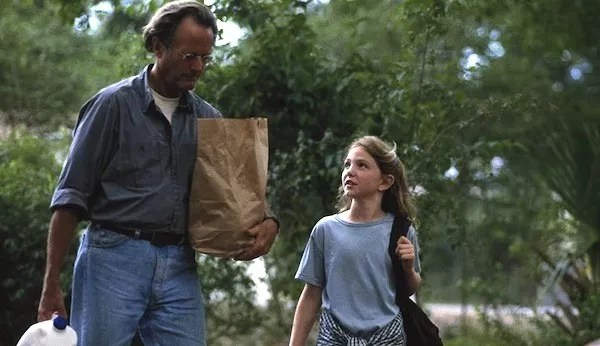
ULEE’S GOLD (1997). From Titanic completely capsizing L.A. Confidential to Helen Hunt winning the Best Actress statue for a subpar turn in As Good As It Gets, the Oscar ceremony for the ’97 season got plenty wrong in what was actually a decent year for cinema. One of the most annoying victories belonged to Jack Nicholson, a great actor who certainly didn’t deserve that Academy Award (his third) for one of his least interesting performances in As Good As It Gets. The better choice was the turn delivered by fellow nominee Peter Fonda, who delivered the performance of his career in this excellent indie hit from writer-director Victor Nunez. Fonda never possessed the talent or enjoyed the success of his dad Henry and his sister Jane, but here he landed a role that beautifully played to his low-key strengths: Ulysses “Ulee” Jackson, a Florida beekeeper silently struggling with the fact that his family has been torn asunder by both internal and external forces. His beloved wife passed away six years ago; his son (Tom Wood) is in prison for robbery; his daughter-in-law (Christine Dunford) is a drug addict; and his two granddaughters (Vanessa Zuma and 15-year-old Jessica Biel in her film debut), who live under his care, constantly ask him difficult questions about their splintered family unit. But even as Ulee attempts to shut himself off from the past, he discovers that circumstances won’t let him, and he soon experiences an unexpected emotional awakening. Nunez made an impression (and racked up Independent Spirit Award nominations) with 1993’s lovely Ruby in Paradise and Ulee’s Gold, but since then, he’s only been able to make two barely seen obscurities. That’s a real shame, since he proved himself to be a refreshing new voice in American cinema. (Hulu)
Related Stories

MST3K, Red Sparrow, The Return of Swamp Thing among new home entertainment titles

Black Panther, Die Hard, It’s Alive Trilogy among new home entertainment titles

Fifty Shades Freed, The House That Dripped Blood among new home entertainment titles

Cold Turkey, Gringo, The Hurricane Heist among new home entertainment titles

The Birth of a Nation, Death Wish, Jack the Giant Killer among new home entertainment titles

Bowling for Columbine, Designing Woman, Night of the Lepus among new home entertainment titles
This article appears in May 30 – Jun 5, 2018.
